Chronic neck pain and stiffness can make everyday activities more difficult. Turning your head, working at a computer, driving, exercising, sleeping, or completing household tasks may become uncomfortable when your neck does not move normally. While occasional neck soreness may improve with time, persistent pain can require professional evaluation to determine what may be contributing to the problem.
Laser therapy is one non-invasive treatment option used at Dr. Kate McDonough in Marshfield, MA. The practice describes laser therapy as a drug-free approach intended to help reduce pain and inflammation while supporting the body’s natural healing response.
Research has also examined low-level laser therapy, sometimes called photobiomodulation, for chronic neck pain. Evidence suggests that it may help reduce pain and improve function for some people, although results can vary depending on the underlying condition and treatment protocol.
Neck pain can develop for many reasons. Poor posture, prolonged computer or screen use, muscle tension, injuries, sleeping position, and age-related changes can all contribute to neck discomfort.
Other potential contributors include disc problems, arthritis, repetitive movements, sports injuries, and whiplash.
Symptoms may include:
Sharp or shooting pain
Headaches that begin around the base of the skull
Numbness or tingling in the arms or fingers
Limited neck motion or pain when turning the head
Muscle weakness in the shoulders or upper limbs
Persistent symptoms should not simply be ignored. Identifying the potential cause of the pain is an important part of determining which treatment may be appropriate.
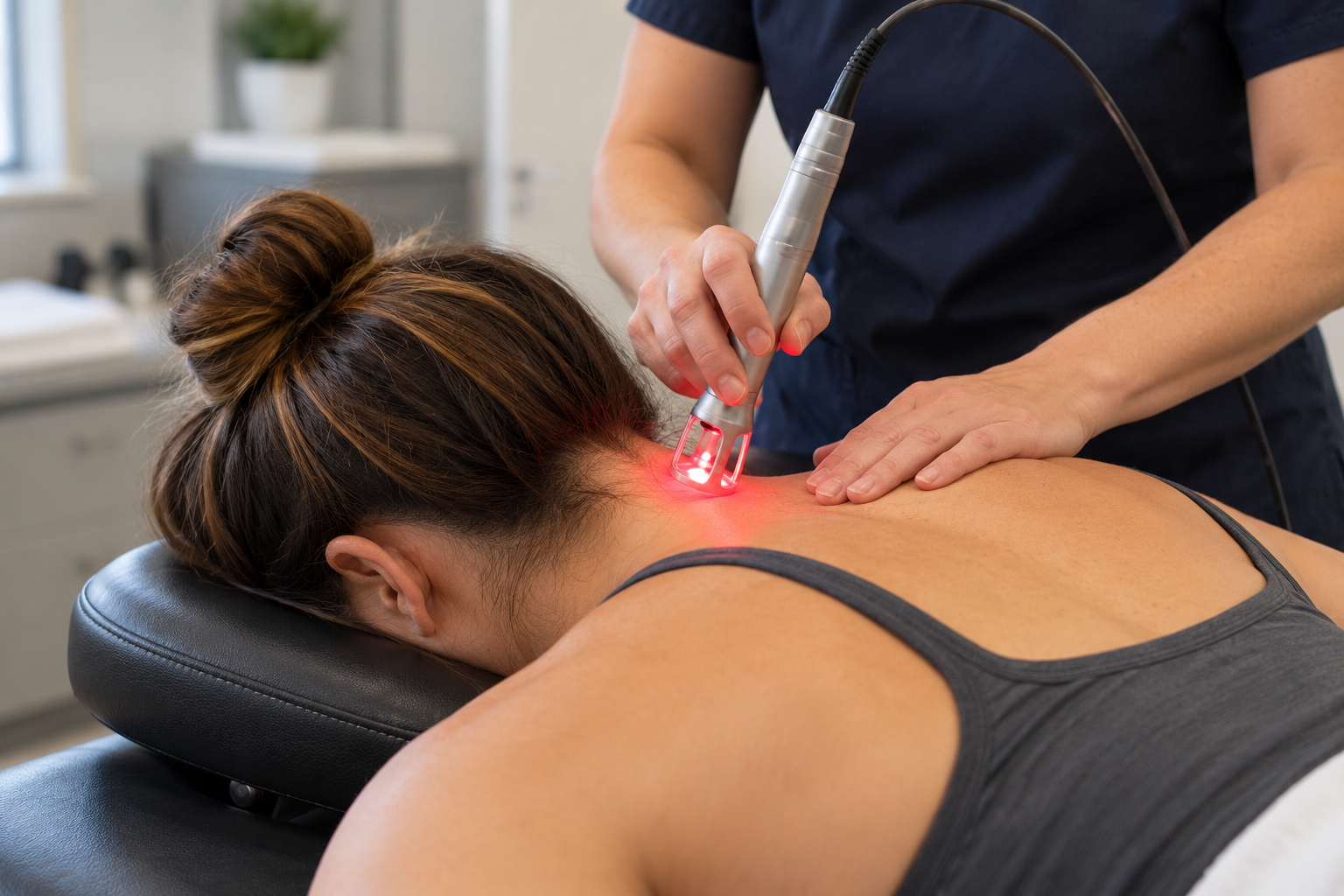
Laser therapy is a non-invasive treatment that uses focused light energy to interact with tissues. It may also be referred to as low-level laser therapy, cold laser therapy, or photobiomodulation.
Dr. Kate McDonough’s practice describes laser therapy as a treatment intended to reduce inflammation, swelling, and pain while supporting tissue repair and the body’s natural healing response.
Unlike surgical procedures, laser therapy does not require an incision. It also does not involve injecting medication into the affected area. Patients generally experience little to no sensation during treatment, although mild warmth or tingling may occur.
The goal is to support the body’s natural recovery processes while helping patients manage discomfort.
For some people, laser therapy may help manage chronic neck pain and stiffness.
Research has found evidence that low-level laser therapy can provide short- and intermediate-term improvements in pain and function for certain people with chronic neck pain. However, treatment results are not identical for everyone, and researchers continue to study the most effective treatment parameters and long-term outcomes.
This means laser therapy should not be viewed as a guaranteed cure. Instead, it may be one component of an individualized approach to managing neck pain.
At Dr. Kate McDonough’s practice, laser therapy may be considered when pain, inflammation, muscle tension, soft-tissue irritation, or other treatable factors are contributing to symptoms.
1. It May Help Reduce Inflammation
Inflammation can contribute to soreness, swelling, tenderness, and restricted movement. Laser therapy is intended to help reduce inflammation and swelling, which may make movement more comfortable.
2. It May Help Reduce Pain
Pain reduction is one of the main reasons people consider laser therapy. Research has reported improvements in pain among some people receiving low-level laser therapy for neck pain.
Individual results can vary, so an evaluation is important before determining whether laser therapy is appropriate.
3. It May Support Tissue Repair
Laser therapy is also intended to support the body’s natural healing processes. Focused light energy may influence cellular activity and support tissue recovery.
This can be particularly relevant when neck symptoms are associated with muscle strain or soft-tissue irritation.
4. It May Support Circulation
Dr. Kate McDonough’s laser therapy information lists improved circulation as one of the potential benefits of treatment. Supporting circulation may contribute to normal tissue recovery.
5. It May Support Better Movement
Pain and inflammation can make the neck feel stiff and restrict normal movement. When discomfort is reduced, some patients may find it easier to move the affected area.
The overall goal is not simply to address pain but to help patients return to more comfortable movement and daily activities.
Dr. Kate McDonough’s practice lists laser therapy as a treatment option for a range of acute and chronic conditions, including:
Acute and chronic pain
Ligament sprains
Muscle strain
Soft tissue injuries
Tendonitis
Arthritis
Tennis elbow
Back pain
Bursitis
Disc pain
Disc Degeneration
Carpal Tunnel Syndrome
Fibromyalgia
Wound healing
Nerve pain
For neck pain, laser therapy may be considered when inflammation, muscle tension, soft-tissue irritation, or other treatable factors are contributing to symptoms.
Laser therapy is designed to be non-invasive and comfortable.
At Dr. Kate McDonough, a typical treatment session takes approximately 4–8 minutes depending on the size of the treatment area. Patients generally experience little to no sensation, although some may notice mild warmth or tingling.
The practice states that laser therapy does not require downtime.
The number of treatments can vary depending on the individual and the condition being treated. Some patients may notice improvement after several treatments, while chronic conditions may require a longer treatment plan.
Treatment recommendations should be individualized based on the patient’s symptoms, condition, and response to care.
Laser therapy is generally considered comfortable. Dr. Kate McDonough’s practice states that treatment is not painful and that patients typically experience little to no sensation.
Some people may notice mild warmth or tingling during treatment. A previously injured or painful area may also feel temporarily sensitive.
Because individual responses differ, patients should discuss any concerns with their healthcare provider.
Yes. Laser therapy does not necessarily have to be used as a stand-alone treatment.
Dr. Kate McDonough states that laser therapy can be administered alongside other therapies, including physical therapy, chiropractic care, massage, soft-tissue mobilization, and electrotherapy.
For neck pain, the practice lists several treatment approaches, including:
Chiropractic Adjustments
Spinal Decompression
Laser Therapy
Muscle Release & Stretching
A personalized treatment plan can address multiple factors that may be contributing to neck discomfort.
Laser therapy is a non-invasive treatment and is generally associated with relatively few side effects. Dr. Kate McDonough’s practice notes that very few side effects have been associated with laser therapy, although previously injured or painful areas can sometimes feel sensitive for a few days.
However, non-invasive does not mean that every patient is automatically a candidate.
People experiencing significant weakness, numbness, tingling, severe radiating pain, or other concerning neurological symptoms should receive an appropriate evaluation.
The underlying cause of neck pain should be considered before selecting a treatment.
There is no single timeline that applies to everyone.
Some patients may notice changes after their first few treatments, while others may need multiple sessions before experiencing meaningful improvement. Chronic conditions can require more treatment than newer or less complicated problems.
Research also indicates that outcomes can vary depending on the condition and treatment parameters.
For this reason, laser therapy should be considered part of an individualized treatment plan rather than a guaranteed one-treatment solution.
1. Can laser therapy help chronic neck pain?
Laser therapy may help some people with chronic neck pain by supporting pain and inflammation management and tissue recovery. Research has found evidence of benefits for certain chronic neck pain patients, although results vary.
2. Is laser therapy painful?
No. Dr. Kate McDonough’s practice states that laser therapy is not painful. Patients may experience mild warmth or tingling during treatment.
3. How long does a laser therapy session take?
A typical session takes approximately 4–8 minutes depending on the size of the treatment area.
4. How many treatments will I need?
The number of treatments depends on the condition and individual response. Dr. Kate McDonough notes that chronic conditions may require multiple treatments.
5. Can laser therapy be combined with chiropractic care?
Yes. Laser therapy may be combined with chiropractic care and other appropriate therapies as part of an individualized treatment plan.
6. Is laser therapy only for injuries?
No. The practice lists both acute and chronic conditions, including chronic pain, arthritis, nerve pain, disc pain, muscle strains, and soft-tissue injuries.
7. Can laser therapy help neck stiffness?
It may. By helping address pain and inflammation, laser therapy may make movement more comfortable for some patients.
8. Does laser therapy require downtime?
Dr. Kate McDonough describes laser therapy as non-invasive and without downtime.
9. When should chronic neck pain be evaluated?
Consider professional evaluation when neck pain persists, repeatedly returns, interferes with daily activities, or occurs with symptoms such as numbness, tingling, weakness, or significant loss of movement.
10. Is laser therapy appropriate for everyone?
Not necessarily. The appropriate treatment depends on the underlying cause of the symptoms and the individual’s overall situation. A professional evaluation can help determine whether laser therapy is appropriate.
You should consider professional evaluation when neck pain continues or begins interfering with normal activities.
Dr. Kate McDonough identifies symptoms such as shooting pain, headaches beginning at the base of the skull, numbness or tingling in the arms or fingers, restricted neck movement, and muscle weakness as symptoms that should not be ignored.
Severe or rapidly worsening symptoms, significant weakness, loss of coordination, or symptoms following serious trauma warrant prompt medical evaluation.
The goal is to understand what may be causing the symptoms before selecting the most appropriate treatment.
So, can laser therapy help with chronic neck pain and stiffness?
For some patients, it may. Research has found evidence that low-level laser therapy can improve pain and function in certain people with chronic neck pain, although outcomes vary and additional research is needed to establish the most effective treatment protocols and long-term effects. Research published by the National Institutes of Health (NIH) has examined the effectiveness of low-level laser therapy for neck pain and provides additional evidence regarding its potential benefits and limitations. The Mayo Clinic also provides guidance on neck pain and when persistent or concerning symptoms should be evaluated by a healthcare professional.
Laser therapy provides a non-invasive approach that may help reduce pain and inflammation while supporting the body’s natural healing processes. At Dr. Kate McDonough’s practice, it is used as part of a personalized approach to conditions including chronic pain, muscle strain, soft-tissue injuries, arthritis, nerve pain, disc pain, and neck pain.
The most important step is determining what may be contributing to your neck symptoms. Once those factors are better understood, an individualized treatment plan can be developed around your symptoms and goals.
If chronic neck pain or stiffness is affecting your comfort, movement, sleep, work, or daily activities, Dr. Kate McDonough can help you explore appropriate treatment options.
Dr. Kate McDonough
📍 Office Address: 844 Webster St, Marshfield, MA 02050, USA
📞 Phone: (781) 635-9697
📧 Email: drkatemcd@gmail.com