
Knee pain can change the way you move, work, exercise, sleep, and enjoy everyday life. A simple walk, a flight of stairs, getting out of a chair, or playing with your children can become uncomfortable when the knee is swollen, stiff, or painful. Many people turn to over-the-counter or prescription pain medication because they need relief quickly. Medication can have a place in healthcare, but it does not always address the inflammation, tissue irritation, or impaired healing contributing to knee discomfort.
Our approach at Dr. Kate McDonough focuses on non-invasive care designed to help the body recover while reducing pain and inflammation. Laser Therapy is one of the services we use to support this goal. It uses focused light energy to work at the cellular level, helping support circulation, tissue repair, and the body’s natural healing response. Our goal is not simply to help you get through another painful day. We want to help you move with greater comfort and build a treatment plan around the reason your knee hurts.
Knee pain can have many causes. Arthritis may gradually affect the joint and lead to stiffness, swelling, and discomfort. A previous sports injury can leave the tissues around the knee irritated long after the original event. Tendonitis, bursitis, ligament sprains, muscle strains, and repetitive stress can also contribute to pain. Changes in movement patterns, alignment, activity level, and body weight may add stress to the knee as well.
Because knee pain is not one single condition, treatment should not be one-size-fits-all. Our first priority is understanding what may be contributing to your symptoms. We consider your history, current symptoms, movement, and goals before determining whether Laser Therapy is appropriate.
A thoughtful evaluation also helps us determine whether the knee pain may be coming from the joint itself or from surrounding tissues. Understanding that distinction matters because successful care should match the underlying problem, not simply chase symptoms whenever they appear during daily activities and physical activity.
Pain medication may reduce discomfort, but symptom relief is not always the same as tissue recovery. According to WebMD, long-term or inappropriate use can also bring unwanted risks or side effects. For someone who wants a non-drug option, Laser Therapy provides another path worth discussing.
Our Laser Therapy service is designed to reduce pain, inflammation, and swelling while supporting the body’s natural healing process. We do not present laser treatment as a replacement for every medication or medical intervention. Instead, it can be a useful part of a broader plan when a patient wants conservative, non-invasive care.
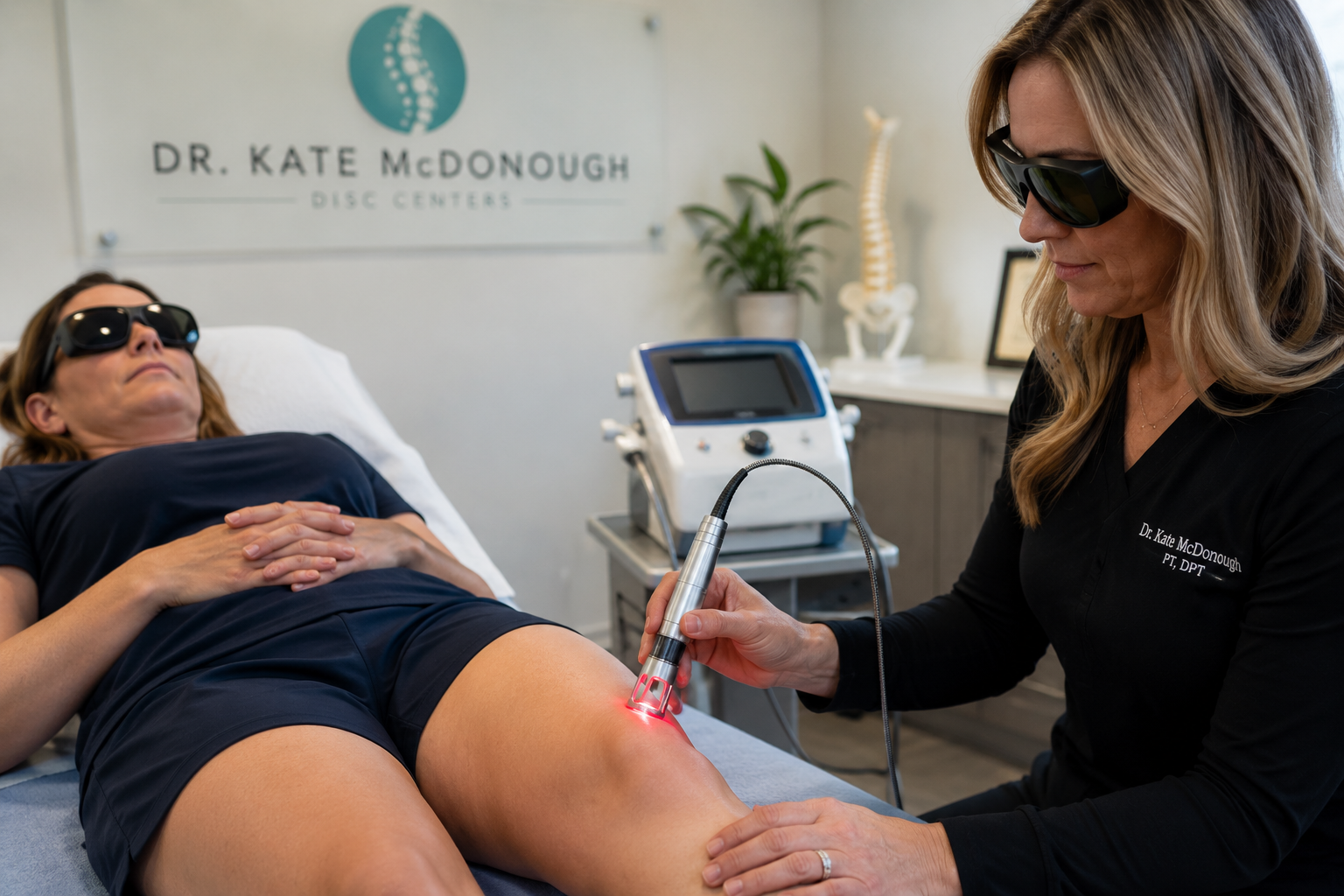
Laser Therapy uses focused light energy directed toward the affected tissues. The light is absorbed by cells and can stimulate biological processes involved in repair. This approach is commonly described as photobiomodulation. By supporting cellular activity, Laser Therapy may help improve circulation, reduce inflammation, and encourage tissue recovery.
Our service is non-invasive, meaning there are no injections, incisions, or surgical procedures involved. Treatment is also designed to be comfortable. According to our Laser Therapy service information, patients generally experience little to no sensation, although some may notice mild warmth or tingling during treatment.
When the knee is painful, inflammation and swelling can make movement more difficult. The body may also respond differently depending on whether the problem is recent or has been present for months or years. Laser Therapy may help by addressing several factors associated with pain and recovery.
First, it may help reduce inflammation. Less inflammation can make movement more comfortable and may support the body’s recovery process. Second, Laser Therapy can help improve circulation in the treated area. Better circulation supports the delivery of oxygen and nutrients that tissues need. Third, the therapy may support tissue repair, which is especially relevant when knee pain involves soft tissue irritation, strain, or injury.
Our website identifies Laser Therapy as an option for arthritis, old injuries, swelling, and stiffness, while our broader Laser Therapy service includes acute and chronic pain, ligament sprains, muscle strains, soft tissue injuries, tendonitis, bursitis, and nerve pain.
Arthritis is one of the most common reasons people experience ongoing knee pain. Osteoarthritis can develop as the protective cartilage within a joint gradually changes, leading to pain, stiffness, swelling, and reduced mobility. Previous injuries, repetitive stress, age-related changes, and other factors can contribute to joint problems.
For people dealing with arthritis-related knee discomfort, our goal is to reduce symptoms while supporting better function. Laser Therapy may help decrease inflammation and pain without adding medication to the treatment plan. It does not rebuild worn cartilage or reverse every structural change caused by arthritis, so expectations matter. Instead, it can be considered as one conservative option for managing symptoms and supporting comfortable movement.
Knee injuries can involve ligaments, tendons, muscles, or other soft tissues. Even after the initial injury has passed, lingering inflammation, stiffness, or sensitivity can make it difficult to return to normal activity.
Our Laser Therapy service can be used for soft tissue injuries, ligament sprains, muscle strains, and tendonitis. By supporting circulation and the body’s healing response, treatment may help create a better environment for recovery. The appropriate plan depends on the type and severity of the injury, so a proper evaluation remains important.
Laser Therapy is designed to be straightforward and comfortable. During a session, the treatment area is identified and the laser is applied to the affected region. There is no incision and no injection. Patients typically feel little to nothing, although mild warmth or tingling can occur.
The number and frequency of sessions can vary. Our service information notes that acute conditions may be treated more frequently, while other patients may receive treatments several times per week, weekly, or every other week. Some people notice improvement after an early session, while chronic problems may require a series of treatments before meaningful changes become noticeable.
We build the schedule around the individual rather than assuming every knee problem needs the same number of visits.
Knee pain often involves more than inflammation alone. A patient may also have movement limitations, weakness, poor mechanics, or another condition affecting the way the knee functions. That is why Laser Therapy does not necessarily have to stand alone.
Our service information explains that Laser Therapy can be used alongside chiropractic care, physical therapy, massage, soft tissue mobilization, and electrotherapy. Depending on the individual’s needs, combining therapies can address different parts of the problem.
For example, reducing discomfort may make it easier to participate in appropriate movement or rehabilitation. Improving mobility and strength can then help support long-term function. The exact combination should be based on the patient’s condition, goals, and response to care.
One of the reasons patients consider Laser Therapy is convenience. Our service is non-invasive and does not require the recovery period associated with surgery. There are also no medications involved in the treatment itself.
That can be especially appealing to people who want to remain active while addressing knee pain. However, “drug-free” does not mean every patient will respond in the same way. Laser Therapy is not a guarantee of pain elimination, and serious or unexplained knee symptoms may require medical evaluation.
Our role is to determine whether conservative care makes sense for your situation and to adjust the plan according to your response.
Laser Therapy may be worth considering if knee pain is related to arthritis, a previous injury, tendonitis, soft tissue irritation, swelling, or chronic pain. It may also be appropriate for someone looking for a non-invasive option that can be combined with other therapies.
However, not every knee problem should be treated the same way. Sudden severe pain, major swelling, an inability to bear weight, a visible deformity, or symptoms following significant trauma deserve appropriate medical assessment. The right treatment begins with identifying what is actually happening.
Our goal is to provide conservative care when it is appropriate, while recognizing when additional evaluation is needed.
No. Our service information states that Laser Therapy is not painful. Most patients experience little to no sensation, although mild warmth or tingling may occur during treatment.
There is no universal number. Our service information indicates that some results may appear after four to six treatments, while chronic conditions may require six to twelve or more treatments. Your response, condition, and goals help determine the appropriate schedule.
Laser Therapy may help reduce pain, inflammation, swelling, and stiffness associated with arthritis. It is a conservative treatment option, but it does not reverse all structural changes caused by arthritis.
Yes. Laser Therapy can be incorporated with other therapies when appropriate. Our service information specifically notes that it may be used alongside chiropractic care, physical therapy, massage, soft tissue mobilization, and electrotherapy.
Some patients report improvement after the first treatment, while others need multiple sessions before noticing a meaningful change. Chronic conditions may take longer to respond.
It can be a non-drug option for managing certain types of pain, but it should not be viewed as a universal substitute for medication. Whether it can reduce the need for medication depends on the individual condition and overall treatment plan.
Living with knee pain does not mean you have to rely only on medication or immediately consider invasive procedures. Laser Therapy offers a non-invasive approach that may help reduce pain and inflammation while supporting circulation and tissue repair.
At Dr. Kate McDonough, our focus is personalized, conservative care. We look at the factors contributing to your knee symptoms and determine whether Laser Therapy fits into a broader plan for improving comfort and mobility. Because every knee problem is different, we do not rely on a one-size-fits-all protocol.
If knee pain is limiting your walking, exercise, work, or everyday activities, now is a good time to have it evaluated. Our team can discuss your symptoms, goals, and available treatment options so you can make an informed decision about your next step.
Dr. Kate McDonough
📍 Office Address: 844 Webster St, Marshfield, MA 02050, USA
📞 Phone: (781) 635-9697
📧 Email: drkatemcd@gmail.com
Our team is ready to help you explore whether Laser Therapy may be an appropriate part of your knee pain care plan. Take the next step toward better mobility and a more active life.